Digital strategy & process automation for a logistics company
G&B Logistics GmbH runs on grown systems and many manual processes. smiit turned that into an actionable digital target architecture — connecting existing systems instead of replacing them, automating time-consuming steps and creating a central data foundation. The automated order capture alone saves around 140 working hours per month.
Published
140 hrs/month
saved by automated order capture alone
- Industry
- Logistics
- Region
- Germany
- Service
- Digital strategy & process automation
- Platform
- Power Platform · Business Central · Power BI
- Timeline
- ongoing partnership
Starting point: manual work between email, ERP, CRM and dispatch
As in many SMEs, G&B Logistics' IT landscape had grown over time: a local dispatch system, Microsoft Business Central, HubSpot, email-based order intake and manually maintained data all ran in parallel. Each system served its purpose — but the processes in between were often manual, time-consuming and hard to scale.
Order processing was especially critical: orders arrived by email as PDFs and had to be read out manually and entered into the dispatch system. Every manual transfer costs time, introduces errors and ties staff to repetitive work — and it was hard to verify whether every incoming order had been fully processed.
On the data side there was no single foundation either: Business Central held ERP and accounting data, HubSpot the CRM-related processes, the dispatch system ran locally, and more information sat in files. There was no central source for analysis, automation or master-data harmonization. The task wasn't to automate individual steps but to develop a digital strategy that connects existing systems sensibly without jeopardizing day-to-day operations.
Solution: a digital target architecture instead of isolated point automations
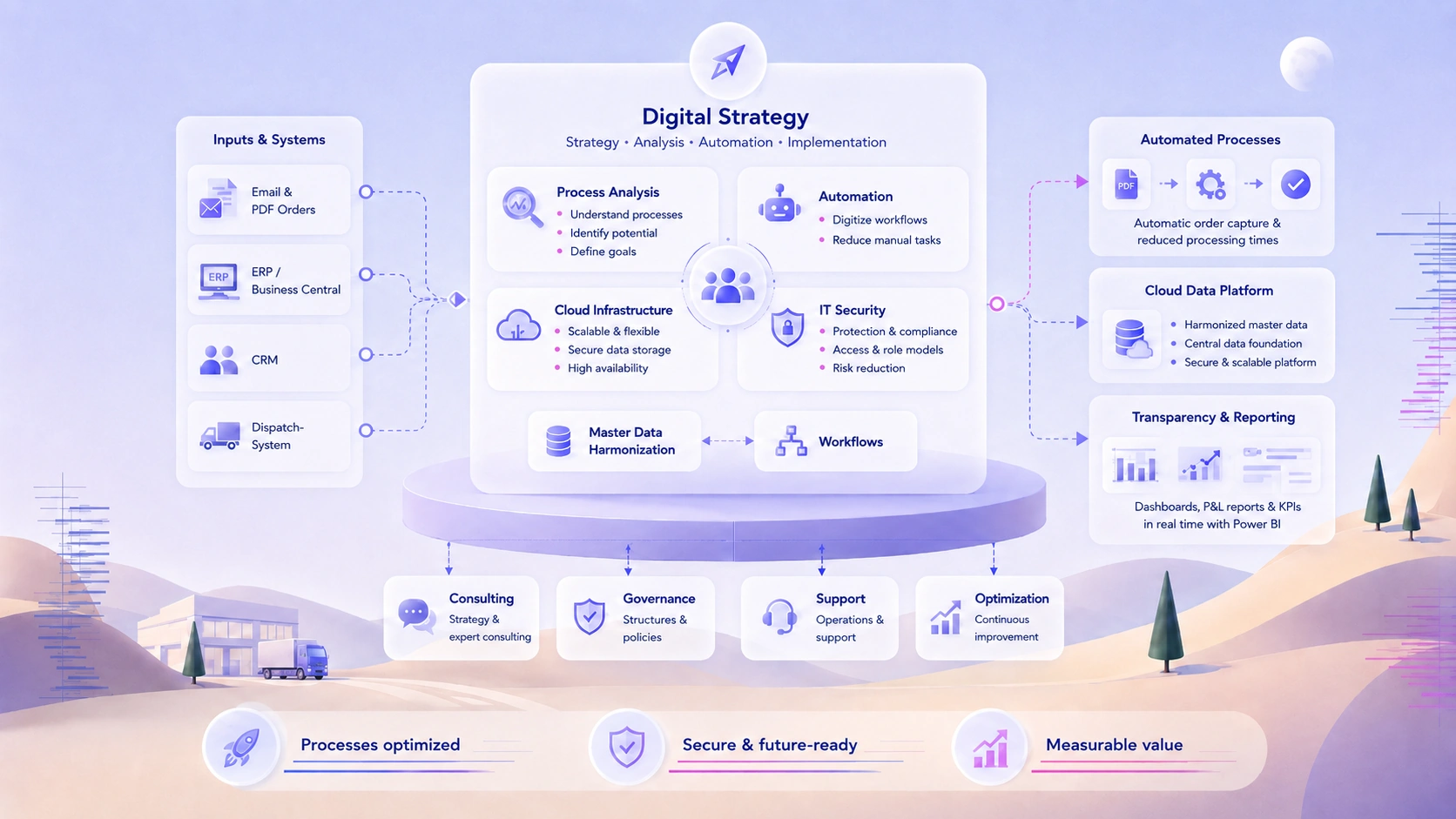
smiit helped G&B Logistics build a digital target architecture for processes, data and systems — deliberately without rebuilding everything. Instead, existing systems were integrated, processes analyzed and automated where it mattered. With grown SME IT landscapes, a full system replacement would be expensive, risky and operationally questionable.
The focus was therefore on connecting existing systems better — Business Central, HubSpot, the local dispatch system, email processes and a new cloud data platform. The result wasn't a theoretical digital strategy but an actionable roadmap with concrete day-to-day improvements, while especially error-prone processes were automated step by step.
Automated order capture with Power Automate and AI Builder
A central building block was automatically processing incoming orders. They still arrive by email as PDFs — a format established with customers and partners that shouldn't be replaced overnight. Instead of changing the intake channel, smiit automated the process behind it: with Microsoft Power Automate and AI Builder, incoming PDF orders are automatically detected, read out and transferred into the dispatch system.
The decision was deliberately pragmatic — external clients didn't have to switch to a new portal or format, while internal manual effort dropped significantly. In addition, a control logic checks whether incoming orders were actually processed: automation in an operational context only makes sense if exceptions and errors stay visible.
This automation alone saves around 140 working hours per month. Even more important is the qualitative effect: staff are relieved of repetitive data entry and can focus more on dispatch, operational coordination and customer communication.
Master data management: creditors, debtors and system harmonization
G&B Logistics maintains information on customers, suppliers, debtors and creditors across several systems. Without central logic, this quickly produces duplicates, inconsistent spellings or contradictory records. smiit therefore planned and implemented a structure to centralize and harmonize master data more strongly — focusing on creditor and debtor data, which is especially relevant for accounting, order processing and reporting.
Technically, this runs on a cloud-based data structure where information from different systems is consolidated and made usable for further processes — whether for harmonization or for downstream checking and reporting. Master data is no longer viewed in isolation but checked, enriched and used across systems: better data quality, less manual coordination and a foundation for further automation.
Cloud data platform and Power BI reporting
Beyond automation and master data, a cloud-based analytics platform was built that makes data from Business Central, HubSpot, the dispatch system and other sources centrally available. On this basis smiit developed Power BI reports that make operational and commercial data more transparent.
A concrete use case is the automated creation of the BWA (business management report): instead of preparing it manually from accounting data, the relevant data is connected and evaluated automatically in Power BI. This creates a repeatable, traceable and faster-available report — financial and company metrics can be analyzed without preparing them manually every time.
Infrastructure, local server and IT security
smiit also supports G&B Logistics on infrastructure — especially the local dispatch system running on a server. Such systems are often business-critical but can't always be moved to the cloud quickly. A hybrid approach was therefore taken: local systems stay where they're operationally needed but are integrated better into the overall architecture, while cloud components improve data availability, analysis and automation.
When local systems, cloud services, automations and interfaces interact, access, data flows and responsibilities have to be cleanly structured. IT security therefore plays a central role: the IT landscape becomes not only more functional but also more controllable and future-proof.
Trade-off: keep using existing systems instead of rebuilding everything
The central tension was between technical modernization and operational stability. A completely new system landscape would be possible in theory, but in practice would mean high costs, long timelines and significant operational risk. smiit therefore chose a pragmatic path: keep using existing systems but improve the transitions between them — Power Automate and AI Builder for recurring steps, the cloud data platform for centralization, Power BI for analysis, interfaces for connection. The result wasn't an abstract IT target picture but a step-by-step modernization with measurable benefit.
Result: less manual work, a better data foundation, scalable processes
G&B Logistics was able to automate core processes, make data available across systems and create the basis for further digitalization. Automated order capture saves around 140 working hours per month and reduces manual transfers; master data management was strategically rebuilt and implemented in the cloud; data from Business Central, HubSpot, the dispatch system and other sources can be analyzed centrally and used for automation.
Power BI created a better basis for operational and commercial analysis, including an automated BWA — while the existing, partly business-critical local infrastructure continues to be supported. The greatest benefit lies in the combination: not individual automations, but a digital strategy connecting processes, data, cloud infrastructure and IT security.
Key figures at a glance
140 hrs
saved per month through automated order capture
4+
core systems integrated: Business Central, HubSpot, dispatch, email
PDF → system
orders read out automatically with Power Automate & AI Builder
BWA
automated instead of manual preparation
Technology & architecture
- Microsoft Power AutomateAutomation of recurring business processes
- AI BuilderAutomatic reading of incoming PDF orders
- Microsoft Business CentralSource for ERP & accounting data
- HubSpotCRM-related data source
- Power BIOperational, commercial & management analysis
- Cloud data platformCentral consolidation of relevant company data
- Local dispatch systemStill business-critical domain system
- Master data harmonizationCreditor & debtor information
- Hybrid IT infrastructureCloud services & local server operation
- IT security & access conceptsControlled data flows & stable processes
Key terms from our glossary
View the glossaryThe core terms around this topic – explained clearly and grounded in practice.
smiit helped us digitize grown processes step by step without disrupting our day-to-day operations. What mattered most was that they didn't just automate individual tasks but developed a clear understanding of our systems, data and workflows.