Why good software doesn't automatically make a scalable business
Building a good software product is only the beginning. What matters is whether it becomes a scalable business model: with a clear target group, recurring revenue, a solid market position and a sales motion that doesn't start from scratch with every new customer.
Many IT service providers know the starting point: the project business runs, customers value bespoke delivery and demand is fundamentally there. At the same time, growth stays tightly coupled to available staff. More revenue usually means more project hours, more coordination and more operational complexity.
A SaaS or platform solution can change that relationship. It doesn't fully replace bespoke services, but it reduces variable costs and generates recurring revenue. Getting there, however, is far more demanding than simply “productising” an existing service.
This article shows which factors are particularly relevant for IT service providers when introducing platform-based software products — and why technology alone rarely determines success.
Why project business hits scaling limits
Classic IT services are valuable, but only scale to a limited degree. The revenue of a consulting, development or data analytics project is usually tied directly to working time: conception, development, coordination, operations and support.
This creates closeness to the customer and enables bespoke solutions. At the same time, variable costs arise with every additional engagement. Growth requires additional capacity, qualified staff and an organisation that becomes more complex as the number of projects increases.
Digital products work differently in economic terms. Their development, maintenance and the build-up of a secure operating environment cause high fixed costs at first. But once the product is available, additional users can often be served at low marginal cost. This is exactly where the scaling potential of software-as-a-service and platform models lies.[1][2]
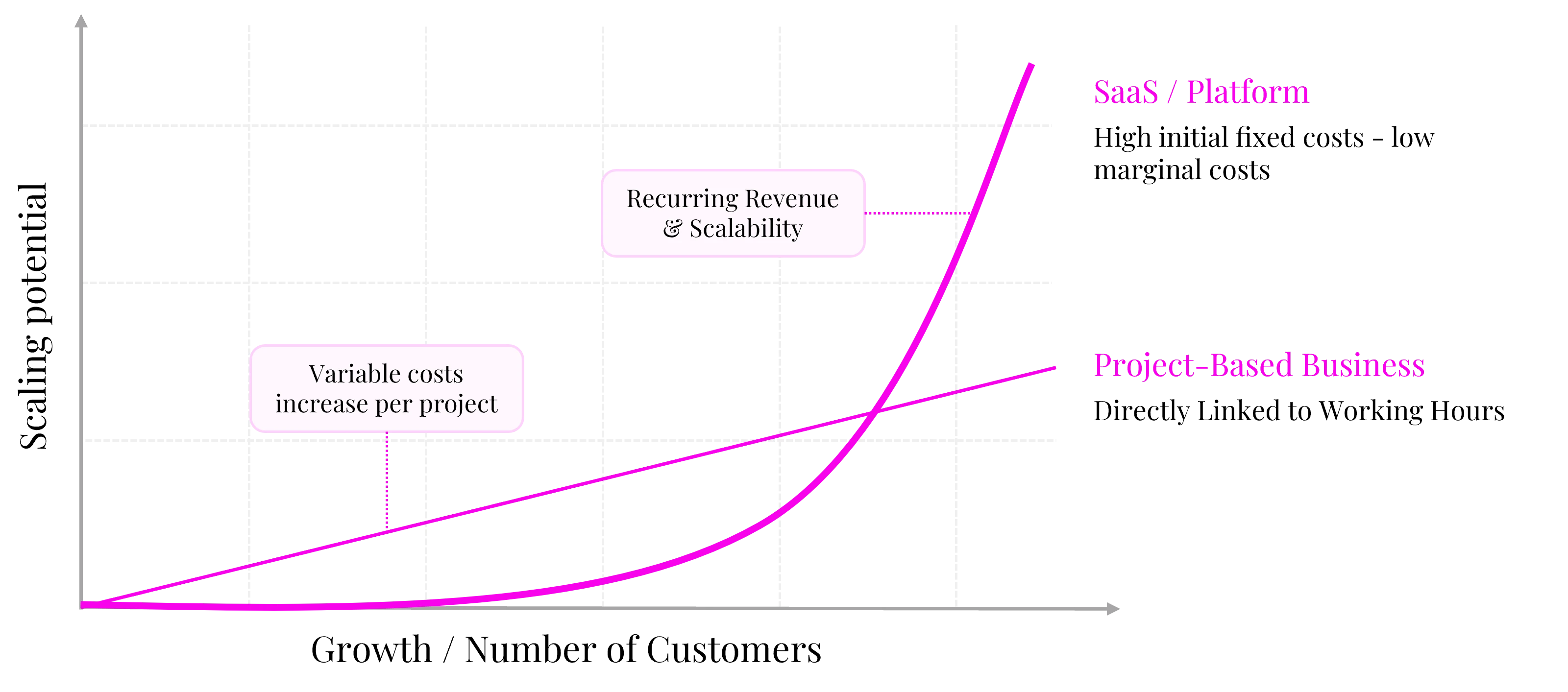
That doesn't mean a SaaS product becomes profitable automatically. On the contrary: the upfront investment shifts. While in project business individual customer engagements generate revenue early, platform providers often first have to invest in product development, market entry, sales, security and operational readiness.[3]
The central question is therefore not “Can we build this software?” but “Can we position, finance and sell a standardised product in such a way that it is used permanently by many customers?”
What the platform economy means in a B2B context
The term platform is often associated with large marketplaces such as Amazon, Airbnb or Uber. These examples represent so-called transaction platforms: they bring two or more market sides together — for example providers and customers — and profit from intermediation, commissions or advertising.[4]
For IT service providers, however, a broader perspective is relevant. The platform economy describes business models in which digital infrastructure, standardised services and repeatable processes enable a disproportionate scaling effect.[5]
Among others, four types can be distinguished:
- Transaction platformsMediate between different market sides, such as customers, service providers or suppliers.
- Innovation platformsCreate ecosystems on which third parties build or distribute their own solutions, for example app stores.
- Integration platformsConnect different systems, data sources and applications.
- SaaS platformsProvide standardised software via a central infrastructure operated by the provider.
For many smaller and mid-sized IT service providers, the last type in particular is relevant. A specialised SaaS product can, for example, standardise reporting, project management, data integration, document management or industry-specific processes.[6][7][8][9]
The difference from bespoke development is not only delivery via the cloud. What matters is the product logic: instead of fully re-implementing individual customer requirements, a reusable core is created that is valuable enough for a clearly defined target group.
SaaS is not automatically a platform
Not every cloud-based software product is automatically a platform. In the B2B space in particular, the terms are frequently conflated.
A classic platform typically benefits from network effects: the value for individual users increases as further users, providers, partners or integrations are added. With marketplaces this relationship is especially visible. The more providers are active, the more attractive the platform becomes for customers — and vice versa.
With SaaS products these effects are often weaker. Accounting software doesn't necessarily get better just because many other companies use it. Nevertheless, SaaS products can also develop platform characteristics:[2]
- Multiple user groupsThe product connects several internal or external user groups.
- Standardised processesIt standardises processes between companies and makes them repeatable.
- Software ecosystemVia interfaces it becomes part of a growing ecosystem of applications.
- Valuable integrationsAdditional integrations increase the value for existing customers.
- Data & partnersData, partners and complementary applications make the product more attractive over time.
Especially in specialised B2B niches, a product can therefore succeed without immediately needing strong network effects like a marketplace. What matters first is a clear, repeatable customer benefit.
From contract work to product ownership
The biggest change when building a software product is usually not technical. It concerns how the company thinks and acts.
In project business, the customer often describes the desired outcome. The IT service provider analyses the requirements, develops a bespoke solution and bills for the work. The need is already concrete, and sales rely heavily on trust, references and personal consulting.[10]
In the platform business the starting point is different. The company itself has to decide:
- Which problem is being solved for which target group?
- Which requirements belong in the product core?
- Which customer wishes deliberately stay outside the standard?
- How is the value communicated clearly?
- Which pricing logic is comprehensible for customers and viable for the provider?
- Which features increase the value for many customers — and which only create one-off effort?
This shifts the role of the service provider. It moves from an implementer to a product company. That requires a clear vision, the ability to prioritise and the courage not to serve every customer requirement individually.
For established service providers in particular, this change can be challenging. Existing customer projects generate short-term revenue and demand attention. A new product, by contrast, needs investment, patience and its own focus. The empirical findings therefore suggest that newly founded platform companies often have better starting conditions than service providers who build a product merely alongside day-to-day business. This is no general law, but an important indication of the organisational and financial latitude required.[11]
The four central fields of action
Building a successful platform or SaaS business cannot be reduced to product development. Four interconnected levels are particularly relevant: strategy, organisation, technology and sales.

1. Strategy: target group, market and business model
At the start there is no feature list, but a clear market decision.
A product is especially viable when it solves a relevant problem for a narrowly defined target group. Smaller IT service providers in particular often benefit from focusing on a niche first: an industry, a specific company size, a recurring process landscape or a concrete data problem.
A broad target group sounds attractive at first, but often increases complexity. Diverging requirements, longer decision paths and an unclear market position make product development and sales harder at the same time.
Strategy also includes:
- DifferentiationA clear distinction from existing solutions on the market.
- Market entryThe right timing for entering the target market.
- Pricing modelA viable pricing and monetisation logic.
- Competitive analysisA realistic picture of providers, substitutes and market dynamics.
- Partners & integrationsA strategy for partnerships and connecting to third-party systems.
- FinancingA financing logic that fits the required upfront investment.
- Product visionA long-term vision for evolving the product.
In the platform economy, market entry is particularly sensitive. Markets with low marginal costs and pronounced network effects can concentrate quickly. Once a few providers have built a strong market position, the barriers to entry rise considerably.[2][3]
For smaller providers this doesn't mean they have to avoid large markets. But it does mean they need a credible differentiation: through industry knowledge, process proximity, integrations, data expertise, a specialised user experience or a particularly well-understood problem.
2. Organisation: product work needs its own ownership
A platform product must not remain merely a side project between customer engagements.
For a product to become market-ready, it needs clear responsibilities. These include decisions about product vision, prioritisation, customer feedback, architecture, quality, go-to-market and further development.
Successful platform companies often work with dedicated, cross-functional product teams. These combine technical expertise with market understanding, product management and a sales perspective. Depending on company size, this doesn't have to be a large team. What matters is that product decisions don't arise solely as a reaction to individual customer projects.
Particularly critical is the balance between standardisation and customer proximity. Customer feedback is indispensable. But it should not turn the product into a collection of individual special cases. A useful guiding question is: does this requirement make the product better for a relevant part of the target group — or does it only solve an individual problem for a single customer? This distinction protects product teams from gradually giving up the scalability of their own offering.
3. Technology: trust is part of the product
Technology is not the only success factor, but it sets the limits of the business model.
B2B customers don't just buy features. They also assess whether software can be operated securely, reliably and in an integrable way over the long term. Especially for data-intensive applications, topics such as data protection, permissions, data export, interfaces, availability, scalability and governance play a central role.
A product doesn't have to have the technical complexity of a global enterprise system from day one. But it should be built so that it can evolve without needing fundamental adaptation for every new customer. The following are particularly important:
- Standardised product coreA reusable core instead of individual one-off solutions.
- Data & permission logicComprehensible management of data and access rights.
- Scalable architectureAn operating architecture that grows with the number of users.
- Clear interfacesDefined interfaces to relevant third-party systems.
- Security & data protectionReliable security and data protection measures.
- Iterative developmentThe ability to expand features step by step.
The technical architecture is therefore not just a cost factor. It is a signal of trust and directly influences how well a product can be sold, operated and scaled over the long term.
4. Sales: service selling is not product selling
An existing sales network in project business is valuable — but no automatic proof that a software product can be marketed successfully.
The reason lies in the different sales logic. Bespoke services often have high deal values. It can therefore be worthwhile to invest several conversations, workshops and consulting days into acquiring a single customer. With a standardised SaaS product, revenue per customer is often lower. Sales costs, onboarding effort and support must therefore be weighed more heavily against the long-term customer value.
The research shows: contacts within the specific target group are particularly valuable, because they facilitate direct sales, trust and credible recommendations. General sales success in a services environment, by contrast, cannot be transferred automatically to a platform product.[5]
For selling a B2B product, this means:
- 1Quickly understandable valueThe product's benefit must be graspable immediately.
- 2A clear problemThe target group must see which risk or effort the product reduces.
- 3Building trustData protection, support and long-term availability must be credible.
- 4A fitting modelPrice, onboarding and contract model must match the customer's maturity.
- 5Networks as door openersExisting contacts ease the entry, but don't replace a robust go-to-market model.
Which success factors show up in practice
The underlying research combines ten semi-structured expert interviews with a qualitative analysis of two established platform companies. The results do not provide universally valid causal laws, but they do show recurring patterns that are relevant for IT service providers in product development and market launch.[11]
Enter the market early with an MVP
An early, functional minimum viable product helps to test market assumptions quickly. What matters is not implementing as many features as possible, but learning early:
- Does the target group understand the offering?
- Is the problem perceived as urgent enough?
- Which features are actually decisive for purchase?
- Which requirements are only supposedly important?
- Is there a genuine willingness to pay?
User feedback is not a one-off validation step here. It has to become part of a continuous product process. Platforms rarely develop successfully along a plan defined entirely in advance. They emerge through repeated cycles of assumption, feedback, prioritisation and improvement.
- 1Form an assumption
- 2Ship the MVP
- 3Gather user feedback
- 4Prioritise insights
- 5Improve the product
- 6Test again
Take the market gap and timing seriously
The timing of market entry can be decisive. In the research, platforms show better prospects of success when they enter markets with few comparable offerings or can clearly occupy an existing gap.[11]
This doesn't mean that only first movers can succeed. A later market entry can work if the provider creates a relevant differentiation. Without a clear market position, however, it becomes difficult to compete against established products with larger budgets, greater brand awareness and more extensive sales resources.
Reorganising as the platform grows
As the platform scales, not only the product changes, but also the appropriate organisational structure. With an initially lean and not very modular platform, a single cross-functional team can closely connect development, business requirements and direct customer feedback. Support, sales or other administrative tasks can often still be bundled with the existing services business at this stage.
But as the platform grows into several functionally independent modules, this structure should evolve: dedicated, cross-functional product teams then take responsibility for individual product areas and their development. Supporting functions such as sales, support or customer success increasingly become relevant as independent, scalable areas. What matters is not an organisation that is as complex as possible, but a structure that creates clear product ownership and prevents the platform from falling back into the logic of classic project business through individual customer requirements.
Sales with limited resources
A product can be technically excellent and still fail.
Especially with smaller IT service providers there is a risk of viewing product development in isolation. One of the most important factors in product development is to think about sales from the very beginning: how do potential customers become aware of us? How do we sell the product cost-efficiently?
If sufficient financial resources are available, platform providers can trial and scale several sales channels in parallel. These include in particular direct sales, targeted online marketing, referral programmes, incentives for word-of-mouth or — for a suitable, attention-grabbing product idea — PR campaigns. What matters is to test the individual channels in a controlled way first and only invest further where customer acquisition costs remain in an economically sensible ratio to the expected customer lifetime value.
The reality for many smaller IT service providers, however, looks different: for the market launch of a new product there are usually no large budgets for sales and customer acquisition. The sales logic should therefore be considered before the actual product development. Companies should check early which target groups they already know, in which industries they have solid contacts, which sales or marketing competencies exist internally and how these strengths can be transferred to the new product.
With limited resources, cost-effective and credible channels gain importance. Existing contacts in the target group, recommendations from satisfied pilot customers, deliberately built word-of-mouth or industry-specific partnerships can be more effective than broadly scattered advertising campaigns. PR, too, can be an efficient lever, provided the product or the underlying problem offers a relevant, tellable story. Direct sales and online marketing remain important options, but with a small budget they should be deployed in a focused, step-by-step way with clear efficiency criteria.
The bottleneck of limited budgets cannot be solved by lower spending alone. Above all, it requires creativity in approaching the market: not every sales channel fits every product. Success is more likely for those who combine their own experience, their existing network and a clearly defined customer benefit so that the first customers can be won with manageable use of resources.
Conclusion: the platform business is an entrepreneurial transformation
Building a SaaS or platform product is not merely an extension of the existing service portfolio. It changes the economic logic, the organisation and the sales of an IT service provider.
The potential is large: recurring revenue, standardised services, better scalability and greater independence from individual project engagements. At the same time, the demands on market understanding, positioning, financing, product management and operational readiness increase.
The most important success factor is therefore not to develop as many features as quickly as possible. What matters is making the right strategic decisions early:
- 1A clearly defined target groupA focused niche rather than a broad, blurry market.
- 2A repeatable customer benefitA relevant problem that can be solved similarly for many customers.
- 3A credible differentiationA clear reason why customers choose this product.
- 4Continuous user feedbackFeedback as an integral part of product development, not a one-off step.
- 5Organisational adjustmentsDedicated ownership and structures for product work.
- 6Realistic resource planningBudget, time and staff honestly aligned with the venture.
- 7A cost-efficient sales conceptA go-to-market that fits limited resources.
This is how a good idea becomes not just a software solution, but a viable digital business model.